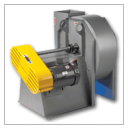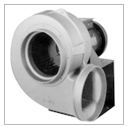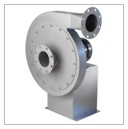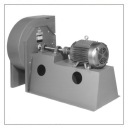
Industrial Fans & Blowers
OVERVIEW:
Many fans and blowers fall under the classifications of Industrial Fans, Industrial Blowers, Industrial Cooling Fans, Industrial Exhaust Fan, Industrial Ventilation Fans, and Impeller Fans. They are all primarily broken down into two types of industrial fans: Centrifugal or Axial.
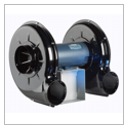
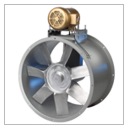
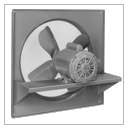
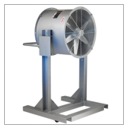
Centrifugal fans or blowers have one of seven types of wheels, normally mounted in a fan or blower housing. The air enters the housing inlet, is turned 90 degrees and is exhausted out of the housing discharge. An Axial fan normally uses a propeller, having 2 or more blades, to draw the air through a section of ductwork or a flat wall panel and out the other side in an axial direction. There is also one type of Axial fan that has a wheel mounted in a section of duct work and is classified as a Tubular Centrifugal.
We will use the term “Fan” for either a fan or blower. To make the proper fan selection, you must consider the following conditions the fan will be subjected to:
- What is the airflow that will be required. This is rated in cubic feet of air per minute
(CFM) or in metric equivalent, it is rated in cubic meters per hour (M³/Hr).
- What is the static pressure through the complete system. This is rated in static
pressure water gauge (SPWG) or in metric equivalent, it is rated in Pascal’s (Pa).
Note: SPWG or Pa is the resistance to flow, or friction, caused by the air moving
through a pipe or duct. Be sure to include losses through filters, dampers, etc.
- What is the temperature of the air going through the fan?
- What is the ambient air temperature outside the fan?
- Will the air stream be clean, dry air?
- If the fan will be used to convey material, answer the following:
a. What is the material?
b. How much does the material weigh, in pounds per cubic foot?
c. How many pounds will you need to convey per hour?
d. Is the material long and stringy or granular?
- Will there be any moisture in the air stream?
- What is the altitude the fan will be operating at?
- Is anything going through the fan that could be explosive?
- Does the location the fan will be operating in contain any explosive material, liquid
or both?
An Axial fan can be used for all the above parameters, except #6 above, if you will be using the fan to convey material. Most Centrifugal fans can be used for any of the above parameters except if conveying material a fan with a forward curve (squirrel cage) wheel is not suitable. The best centrifugal wheel type for conveying material is a radial wheel or an open radial wheel. If the material you will be conveying is log and stringy, like paper trim or fibers, only an open radial wheel should be used.
Cincinnati Fan does not manufacture any consumer or residential type fans or blowers. But, we do manufacture 35 models of axial fans and centrifugal blowers that are designed and constructed as industrial type. We manufacture fans and blowers in the ¼ to 125 horsepower range, with airflow capacities from 50 to 48,500 CFM and static pressures from 1/8” to 78” SPWG.
APPLICATIONS:
While a list of all the applications industrial fans and blowers are used for would be extremely long, the most common are:
Centrifugal Fans & Blowers:
- Conveying material in dust collector systems or loading to silos, trucks and railroad cars.
- Combustion air for burners and industrial water heaters.
- Cooling electrical equipment or parts from heat curing ovens and kilns.
- Pressurizing cabinets, vaults or rooms.
- Blow-off systems to remove moisture from parts prior to painting, coating or packing.
- General ventilation of rooms or factories.
- Providing suction or pressure for industrial process air flotation tables.
- Drying ink on cans and bottles, silk screen and printing processes.
- Food processing.
- Circulating air in ovens and dryers to eliminate cold spots.
- Forced ventilation of AC and DC motors, traction motors and electrical cabinets.
Industrial Axial Fans:
- Paint spray booth exhaust.
- Fume hood exhaust.
- Exhausting dangerous fume away from the operator.
- Welding fume exhaust for welding booths.
- Process cooling and exhaust of machinery and/or systems.
- People cooling in hot work areas.
- Forced cooling and exhausting heat in steel mills.
- Forced cooling for kilns, ovens and forges.
- Exhausting mist and vapor in paper mills or industrial parts washers prior to
painting parts.
- General ventilation using supply air and make-up air in factories, foundries and
warehouses.
Call us or our sales office for your area. We most likely have already built industrial fans and blowers for your application.
BENEFITS:
The benefits of Cincinnati Fan industrial fans and blowers are:
- Most all types and models, with most accessories, are shipped within 10-15 working
days. Some models available on a 5 Day RUSH program, with most accessories.
Quicker than industry standards.
- Spark resistant, cast aluminum wheels are standard in our PB and SPB Models and cast
aluminum props are standard in most of our Axial Fan Models. Ideal for applications requiring any spark resistant requirement and quick deliveries.
- Heavy duty, industrial components and continuous duty motors ensures long lasting
operation minimizing equipment down time. Dependable service with few field
problems.
- All aluminum or all stainless steel fan construction is “not special” for us. We manufacture
most models with both types of construction almost weekly. Faster delivery to you.
- All of our centrifugal blowers and fans are available with multiple wheel sizes and some
are also available with multiple housing widths from 50 to 100% in 5% increments. Direct
driven fans can be selected instead of larger, heavier, more expensive belt driven fans.
Less expensive, more compact and lighter weight. Design flexibility.
- Belt driven models utilize wider spacing between the fan bearings which increases the
bearing life. Less down time before replacement bearings are needed.
- Service! Without it, all the above is meaningless. We pride ourselves and are highly
respected in the fan industry for the quality and service we give all our customers.
Let us prove it to you also.
The above is why we are “The OEM and Industrial Air Handling Specialists”.
|